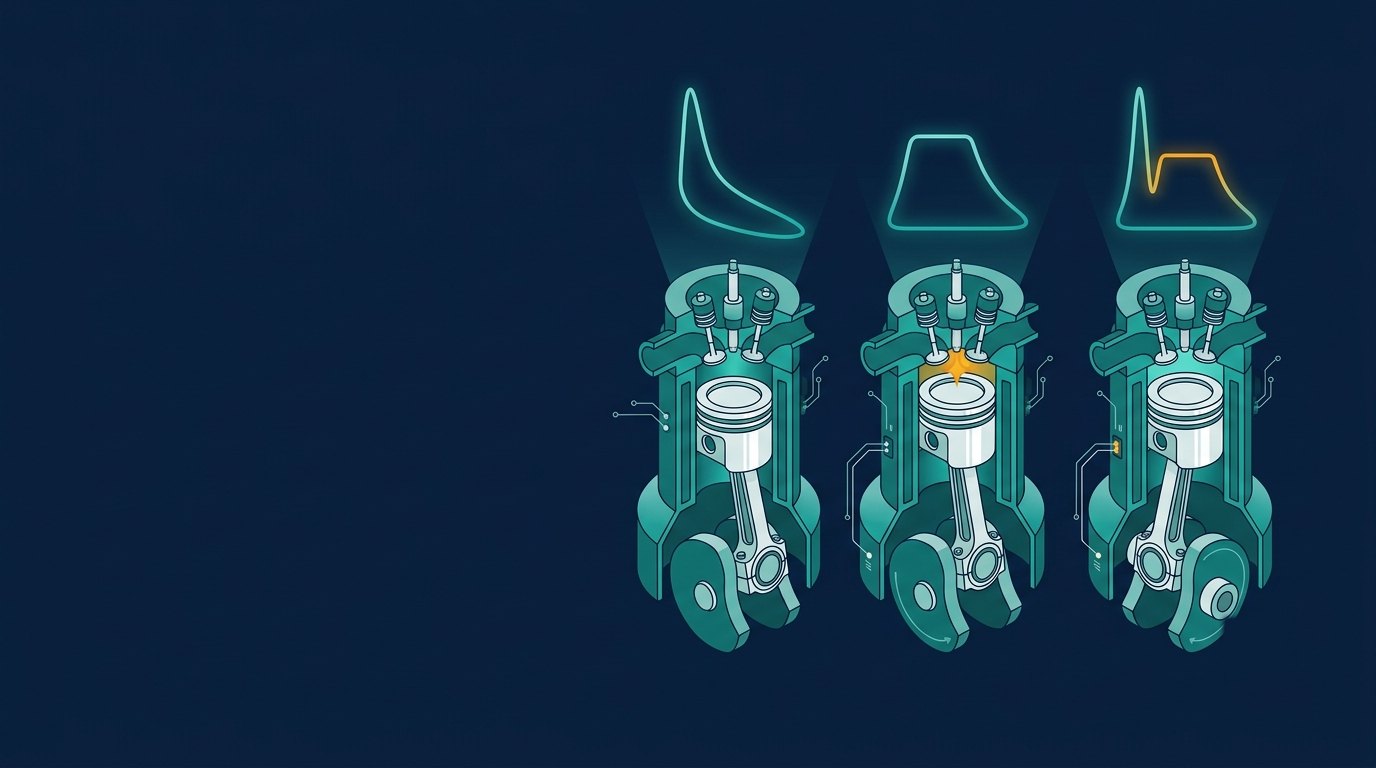
Why does a petrol engine beat a diesel engine on paper, yet a diesel engine wins the fuel-economy race on the road?
If that question has ever made you stare at your thermodynamics notes at 1 a.m., welcome. The short answer is that the three classic engine cycles, Otto, Diesel and Dual, are idealised models, and the comparison only makes sense when you know exactly which variable is being held equal. In this guide we will go through each cycle process by process, write down the efficiency formulas with every symbol defined, run a worked example, and finish with the mistakes that quietly cost exam marks.
This post is for engineering students (including GATE and university exam preparation) and curious beginners. It is educational only: the numbers are ideal textbook values, not predictions for a real engine.
First, the air-standard assumptions
A real engine burns fuel, breathes in fresh air and throws out exhaust. That is messy to analyse. So we simplify using the air-standard approach:
- The working fluid is a fixed mass of air, treated as an ideal gas.
- Specific heats are constant (in the simplest version, gamma = 1.4 for air).
- The cycle is closed: the same air goes round and round, with no intake or exhaust strokes.
- Combustion is replaced by heat addition from an outside source, and exhaust is replaced by heat rejection.
- All processes are internally reversible, so compression and expansion are isentropic (no friction, no heat loss).
Two symbols appear everywhere. The compression ratio r = V_max / V_min, the cylinder volume at the start of compression divided by the volume at the end. And gamma = cp / cv, the ratio of specific heats.
The Otto cycle: heat added at constant volume
The Otto cycle models the spark-ignition (petrol) engine. The spark lights a premixed charge so quickly that the piston barely moves, which we idealise as heat addition at constant volume.
- 1-2: isentropic compression (volume falls from V1 to V2).
- 2-3: constant-volume heat addition (pressure and temperature jump).
- 3-4: isentropic expansion (the power stroke).
- 4-1: constant-volume heat rejection (back to the start).
eta_Otto = 1 - 1 / r^(gamma - 1)
Notice that the Otto efficiency depends only on r and gamma. Double the compression ratio and efficiency rises, but with diminishing returns.
The Diesel cycle: heat added at constant pressure
The Diesel cycle models the compression-ignition engine. Air alone is compressed to a high pressure and temperature, then fuel is injected and burns while the piston is already moving down. That slower, sustained burn is idealised as heat addition at constant pressure. (New to the hardware? Our guide to how diesel engines work covers injection, turbocharging and more.)
- 1-2: isentropic compression.
- 2-3: constant-pressure heat addition (volume grows from V2 to V3).
- 3-4: isentropic expansion.
- 4-1: constant-volume heat rejection.
eta_Diesel = 1 - (1 / r^(gamma - 1)) * (rc^gamma - 1) / (gamma * (rc - 1))

rc = V3 / V2   (cutoff ratio: volume at the end of heat addition / volume at the start)
The cutoff ratio rc is always greater than 1, because the gas expands while heat is added. The bigger rc is (more fuel burned per cycle, so more load), the lower the ideal efficiency. As rc approaches 1, the extra fraction tends to 1 and the Diesel formula collapses to the Otto formula.
The Dual cycle: a bit of both
Real diesel combustion is not purely constant pressure. The first injected fuel burns quickly (close to constant volume), and the rest burns as the piston descends (close to constant pressure). The Dual cycle, also called the Sabathe cycle, captures this with two heat-addition steps.
- 1-2: isentropic compression.
- 2-3: constant-volume heat addition (pressure rises).
- 3-4: constant-pressure heat addition (volume grows).
- 4-5: isentropic expansion.
- 5-1: constant-volume heat rejection.
eta_Dual = 1 - (1 / r^(gamma - 1)) * (alpha * beta^gamma - 1) / ((alpha - 1) + gamma * alpha * (beta - 1))

alpha = p3 / p2   (pressure ratio during constant-volume heat addition)
beta  = V4 / V3   (cutoff ratio during constant-pressure heat addition)
Two sanity checks help you remember it. Set beta = 1 (no constant-pressure part) and you get the Otto formula. Set alpha = 1 (no constant-volume part) and you get the Diesel formula. The Dual cycle is the family that contains both.
Notation warning: textbooks use different letters. Some write rho for the cutoff ratio, some use K or alpha for the pressure ratio. Always define your symbols before writing the formula in an exam.
P-V and T-S diagrams in words
Sketching these is a classic exam task, so here is what each line looks like. On a P-V diagram, volume is on the horizontal axis and pressure on the vertical axis. An isentropic process is a steep, curved line (p times V^gamma is constant), a constant-volume process is a vertical line, and a constant-pressure process is a horizontal line. On a T-S diagram, an isentropic process is a vertical line, and constant-volume lines are steeper than constant-pressure lines when both rise in temperature.
| Process | Otto (P-V / T-S) | Diesel (P-V / T-S) | Dual (P-V / T-S) |
|---|---|---|---|
| Compression | 1-2: curve up and to the left / vertical line up | 1-2: same | 1-2: same |
| Heat addition | 2-3: vertical line up / curve rising to the right | 2-3: horizontal line to the right / curve rising to the right, flatter than a constant-volume line | 2-3: vertical line up, then 3-4: horizontal line to the right / two rising curves, steeper then flatter |
| Expansion | 3-4: curve down and to the right / vertical line down | 3-4: same | 4-5: same |
| Heat rejection | 4-1: vertical line down / curve falling back to state 1 | 4-1: same | 5-1: same |
In the P-V picture, the enclosed area is the net work per cycle. In the T-S picture, the enclosed area is the net heat, which equals the net work for a cycle. The Dual loop looks like an Otto loop whose top has been pushed into a short flat roof.
Otto vs Diesel vs Dual: comparison table
| Feature | Otto | Diesel | Dual |
|---|---|---|---|
| Ignition | Spark ignition | Compression ignition | Compression ignition (modelled with mixed burning) |
| Heat addition | Constant volume | Constant pressure | Constant volume, then constant pressure |
| Heat rejection | Constant volume | Constant volume | Constant volume |
| Efficiency depends on | r, gamma | r, rc, gamma | r, alpha, beta, gamma |
| Typical real compression ratio | Roughly 8 to 12 (limited by knock) | Roughly 14 to 22 | Similar to diesel |
| Fuel | Petrol (gasoline), and similar volatile fuels | Diesel oil | Diesel oil |
| Real-world engines | Cars, scooters, small petrol engines | Trucks, buses, tractors, generators | Closest model of modern high-speed diesel engines |
The compression-ratio ranges are approximate figures from a teaching reference; real values vary by engine design, fuel and year, so check the datasheet for any specific engine.
Why Otto wins on paper but diesel wins on the road
Here is the twist. At the same compression ratio and the same gamma, the Otto cycle is more efficient than the Diesel cycle. The reason is in the formulas: the Diesel expression is the Otto expression multiplied by the factor (rc^gamma – 1) / (gamma * (rc – 1)), which is greater than 1 whenever rc is greater than 1. A bigger loss term means lower efficiency. Intuitively, in the Diesel cycle part of the heat is added while the piston is already moving down, so that portion gets expanded through a smaller effective expansion ratio and is converted to work less efficiently. For the same r, the ordering is Otto, then Dual, then Diesel.
But nobody runs both engines at the same compression ratio. A petrol engine draws in a fuel-air mixture, so squeezing it too hard makes it ignite by itself (knock). A diesel engine compresses air only and injects fuel afterwards, so it can use a much higher compression ratio. Since efficiency climbs with r, that advantage can outweigh the Diesel cycle’s penalty. Real diesel engines also usually run lean and control power by the amount of fuel injected rather than by throttling the air, which avoids much of the pumping loss a throttled petrol engine suffers at part load. Put together, these are the standard explanations for the diesel’s better real-world fuel economy. They are not guarantees: the gap depends on the engine, load and operating point.
There is also a second comparison worth knowing. If you hold the maximum pressure and the heat input equal (the practical limit of engine structure), the Diesel cycle comes out more efficient than the Otto cycle. So the answer to “which is better?” is always “better at what constraint?”
Worked numerical example
Take gamma = 1.4 for all three cycles. The results below were computed in Python and cross-checked by calculating the Dual cycle directly from temperatures and heat flows.
- Otto, r = 8: eta = 1 – 1 / 8^0.4 = 56.5%
- Diesel, r = 18, rc = 2: eta = 1 – (1 / 18^0.4) * (2^1.4 – 1) / (1.4 * (2 – 1)) = 63.2%
- Dual, r = 16, alpha = 1.5, beta = 1.3: eta = 66.0%
These are ideal air-standard values, not real engine efficiencies. Real engines land far lower, for reasons we cover next.
Now the same-compression-ratio test. Keep r = 8 and rc = 2 for the Diesel cycle: its ideal efficiency drops to about 49.0%, well below the Otto cycle’s 56.5%. And the other way round, an Otto engine at r = 18 would give an ideal 68.5%, but a real petrol engine cannot run there because of knock. The example shows both halves of the story: Otto wins at equal r, and diesel gains by being able to raise r.
From ideal to real
The gap between those 56 to 66% figures and what a real engine delivers comes from several effects the air-standard model ignores:
- Friction: piston rings, bearings and the valve train all eat useful work.
- Heat loss: cylinder walls and coolant carry heat away instead of letting it become work.
- Incomplete or non-instant combustion: real burning takes time and is never perfectly complete.
- Variable specific heats: cp and cv of real gases rise with temperature, and gamma falls, which lowers the ideal efficiency compared with the gamma = 1.4 assumption.
- Pumping losses: pushing gas in and out of the cylinder costs work, especially in a throttled petrol engine at part load.
Real efficiency also depends on how the engine is used. If you want to see why load and operating pattern matter so much in practice, read why diesel engine duty cycles decide engine life. And for a small petrol-engine example where compression, clutches and gearing all meet, see our go-kart powertrain explainer or the broader go-kart engineering guide for beginners.
Common exam mistakes
- Mixing up symbol definitions. In the Diesel cycle rc = V3 / V2. Some questions give the expansion ratio instead, so read what is given before plugging in.
- Confusing compression ratio with cutoff ratio. r = V1 / V2 is about the whole compression stroke. rc is about how long heat is added. They are different numbers with different roles.
- Forgetting gamma in the Diesel and Dual formulas. The factor gamma multiplies (rc – 1) in the denominator. Dropping it is the most common algebra slip.
- Unit slips. Use absolute temperature (kelvin) and absolute pressure. Efficiency is dimensionless, so give it as a fraction or a percentage, not in kilojoules.
- Comparing cycles without a stated constraint. Write “for the same compression ratio” or “for the same maximum pressure and heat input” in your answer.
FAQ
Which cycle is the most efficient?
It depends on the comparison basis. At the same compression ratio, Otto is highest and Diesel is lowest, with Dual between them. At the same maximum pressure and heat input, Diesel is higher than Otto. In real engines, diesel engines are usually more efficient because they run at higher compression ratios.
Why do we need the Dual cycle at all?
Because real high-speed diesel combustion is neither purely constant volume nor purely constant pressure. The Dual cycle is a better model of that mix, and it reduces to Otto or Diesel as special cases.
Does a higher compression ratio always mean better efficiency?
In the ideal formulas, yes, with diminishing returns. In real engines, higher compression raises peak pressure and heat loss, and in petrol engines it is limited by knock, so there is a practical optimum.
Final thought
The big lesson is that an efficiency formula is only as meaningful as the constraint behind it. Otto, Diesel and Dual are three views of the same idea, adding heat to compressed air, and the differences come from when and how that heat arrives. Master the process tables and symbol definitions and the algebra follows.
Which cycle tripped you up most in your exams, and which question would you like a full step-by-step solution for? Tell us in the comments.
Every formula you need, in one place
The Mechanical Engineering Formula Handbook covers 140+ core formulas across 12 subjects, with symbols, SI units and notes on when to use each one. Ideal for exams and quick checks at work. Want the full kit? The Engineer Toolkit Bundle adds calculators, Excel practice and AI prompts for engineers.
Prefer video? Watch the tutorials on YouTube · Browse all toolkits