

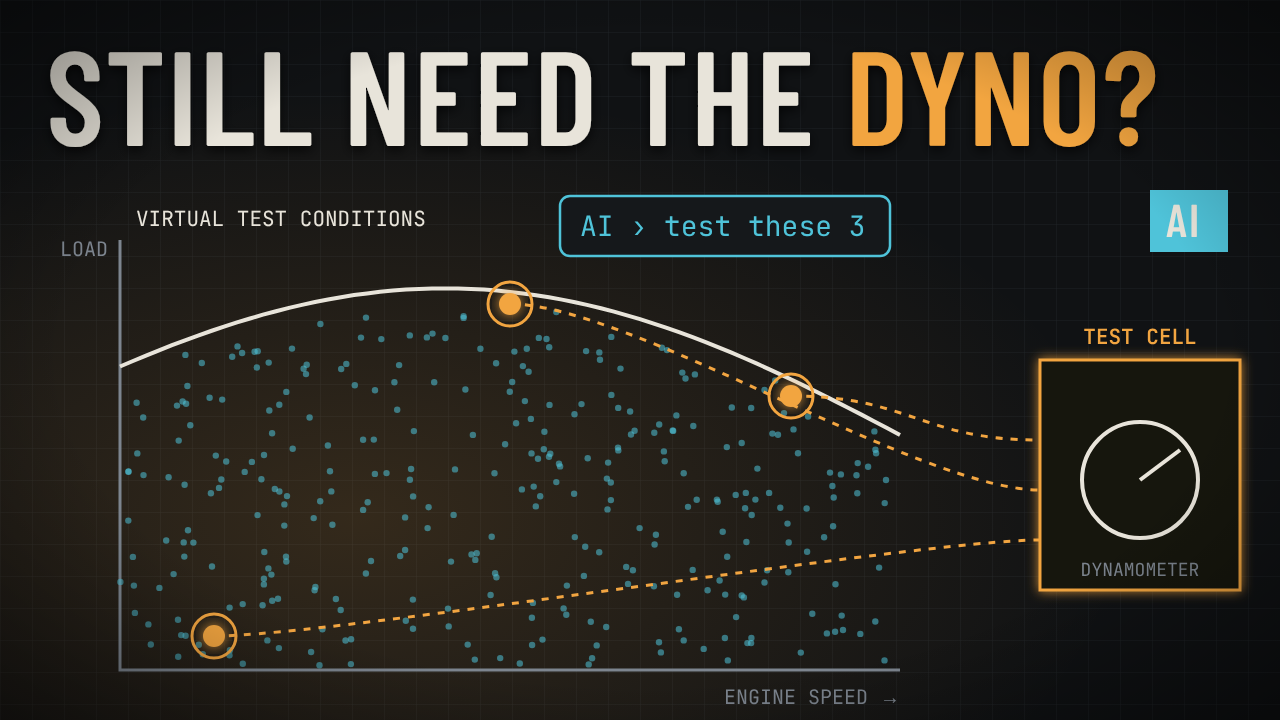
Quick answer: no, not completely. Machine learning and digital twins can predict torque, fuel consumption and emissions between conditions already tested, which cuts repetitive tests, parameter sweeps and early calibration work. But data-driven models are weak at extrapolating to conditions they have never seen and give no warning when they are wrong, and emissions certification still requires dynamometer and on-road tests. AI reduces engine testing; it does not replace it.
Imagine running thousands of engine tests without ever starting the engine. Machine-learning models can now learn how an engine behaves from test-cell data and predict torque, fuel consumption and exhaust temperature at conditions they have never directly seen. So do we still need the test cell?
Short answer
- No, not completely. AI can cut the number of physical engine tests, but it cannot yet replace the dynamometer.
- Where AI helps: predicting torque, fuel use and exhaust temperature between tested points, choosing which tests to run next, and spotting early signs of failure.
- Where it fails: data-driven models extrapolate poorly outside their training range, and they give confident answers when they are wrong.
- What stays physical: emissions certification, safety, durability and final validation of anything new.
What “engine testing” actually means
Engine testing isn’t one test. It’s performance and full-load curves, fuel consumption, emissions, thermal behaviour, durability running for thousands of hours, NVH, transient response, cold starts, altitude, and engine mapping, where speed and load are swept to build the calibration tables the ECU runs on. All of it needs prototype engines, dynamometers, instrumented test cells, fuel, skilled operators and, above all, time. A test cell runs one engine at one condition at a time.
Simulation predicts, testing validates
1D engine models, combustion CFD and FEA are very good at predicting. But a prediction is still a claim about reality, and testing is how we check it. Keep that distinction in mind; it decides the answer.
What AI can already do
- Performance prediction: feed a model speed, load, fuel quantity, injection timing, airflow and ambient conditions, and it predicts torque, power, BSFC and exhaust temperature in milliseconds.
- Smarter experiments: active-learning methods let the model request a test exactly where it is most uncertain. Calibration vendor Secondmind reports a 65% cut in test-cell occupancy for one supplier, and a 59.7% cut in engineering hours in a Mazda case study. These are vendor-reported figures; treat them as claims to verify.
- Failure prediction: models trained on healthy operation flag subtle deviations in vibration, oil pressure or exhaust temperature before they become failures. Researchers have shown vibration signatures alone can diagnose diesel fuel-line faults (SAE 2024-26-0221).
- Digital twins and virtual testing: a team at Politecnico di Torino built a hybrid physics + machine-learning virtual test rig for a 1.6-litre diesel, optimised the calibration virtually, then confirmed the improvement on a real test bench (Boccardo et al., 2022).
Want to try the failure-prediction idea yourself? Our predictive maintenance tutorial builds a bearing fault classifier in Python step by step, and our list of free machine learning datasets for mechanical engineers includes NASA’s turbofan engine degradation data.
Where AI fails: the extrapolation problem
A data-driven model is excellent at interpolation, filling in between points it has seen. It is much weaker at extrapolation. Peer-reviewed work on diesel calibration models shows they perform poorly outside their training range unless physics is built in (Brahma, SAE Int. J. Engines, 2019). And engines leave that range more often than you’d think: extreme ambient temperatures, altitude, wear, manufacturing variation, fuel quality, sensor faults, new hardware, unusual transients, combustion instability.
The dangerous part: when the link between training data and the real engine breaks, the model doesn’t tell you it’s wrong. It just gives you a confident answer.
Certification still runs on real engines
US heavy-duty engines must pass dynamometer test cycles such as the SET, and Europe’s Euro 7 rules (applying to new car types from November 2026) still rely on dynamometer and on-road (PEMS) emissions measurement. A prediction, however good, is not yet accepted as proof.
The realistic workflow: a loop, not a line
Design, simulate, build a prototype, collect test-cell data, train models, predict thousands of conditions, pick the risky, uncertain and new ones, test those physically, and feed the results back. Simulation, testing, data, AI, prediction, and back to testing.
So, can AI replace engine testing?
Probably not completely. But AI will increasingly replace unnecessary engine testing. Repetitive tests, big parameter sweeps and early calibration shrink; safety, certification, final validation and anything genuinely new stay physical. The future isn’t a test cell without engineers. It’s an engineer with AI deciding exactly which tests are worth running.
Frequently asked questions
What can machine learning already do in engine testing?
Trained on test-cell data, models can predict torque, fuel consumption and emissions across many operating points, help with calibration, and flag early signs of failure. That lets engineers test fewer points physically.
Why can’t a digital twin replace the dyno?
A data-driven model is good at interpolation (filling in between points it has seen) and weak at extrapolation. New hardware, fuels, ambient conditions or wear can break the link between training data and the real engine, and the model will still give a confident answer.
Is emissions certification still done on real engines?
Yes. US heavy-duty engines must pass dynamometer test cycles, and Europe’s Euro 7 rules still rely on dynamometer and on-road (PEMS) emissions tests.
Which engine tests is AI most likely to reduce?
Repetitive tests, large parameter sweeps and early calibration. Safety, certification and final validation tests stay physical.
Watch the full 10-minute breakdown above, and tell me in the comments: in your test cell, which tests do you think AI could remove first?
Want a step-by-step plan for learning machine learning?
The 90-Day Machine Learning Roadmap takes you from Python basics to a deployed ML portfolio in 13 weeks, with a plan for every day and a progress tracker. Going for your first ML or data science job? The ML Career Bundle adds an interview kit, Python practice and resume templates.
Prefer video? Watch the tutorials on YouTube · Browse all toolkits
Sources
- Boccardo, G. et al. (2022). Development of a virtual methodology based on physical and data-driven models to optimize engine calibration. Transportation Engineering, 10, 100143. doi:10.1016/j.treng.2022.100143.
- Brahma, I. (2019). Extending the Range of Data-Based Empirical Models Used for Diesel Engine Calibration by Using Physics to Transform Feature Space. SAE Int. J. Engines, 12(2), 185-202.
- Chaudhari et al. (2024). Intelligent Diagnosis for Fuel Line Fault of Diesel Engine Based on Vibration Signatures. SAE Technical Paper 2024-26-0221.
- Secondmind (vendor-reported). Calibration.
- DieselNet. Supplemental Emission Test (SET).
- HORIBA. Euro 7 FAQ.

3 responses to “Can AI Replace Engine Testing? Machine Learning, Digital Twins and the Dyno”
[…] are excellent at filling in between conditions they have seen and weak outside them, which is why AI has not replaced physical engine testing, even where it cuts test […]
[…] same honesty question applies across engineering. Our look at whether AI can replace engine testing shows why models trained on test-cell data still need physical validation outside the conditions […]
[…] calculator is a good small Python exercise built on engineering formulas, and our look at whether AI can replace engine testing shows where these models help in industry and where they still fall […]